Page 7 of 8

Adventure in Italy: Sirmione

Since Brian had already been traveling for two months, he opted to take a day off, so Amy and I went on our own to see Sirmione on Lake Garda; a spit of land that extends into a mountain lake and features a beach castle and the ruins of a Roman villa.

The Sirmione Peninsula

One thing we did not anticipate was heavy traffic.  It seems that August is when a lot of Italians take vacation, especially on a Friday going into a holiday week.  As soon as we arrived on Sirmione, we passed a few beach tourist plazas, and then we were at a standstill.  We’d already learned how hard it is to find parking in Italy, so when we saw the main parking lot shut down (two cars ahead of us!), we turned around and parked at a further lot, snagging a space out of sheer luck.  Then we resigned ourselves to a long, long walk.  In summer heat.  During a heatwave in Italy.

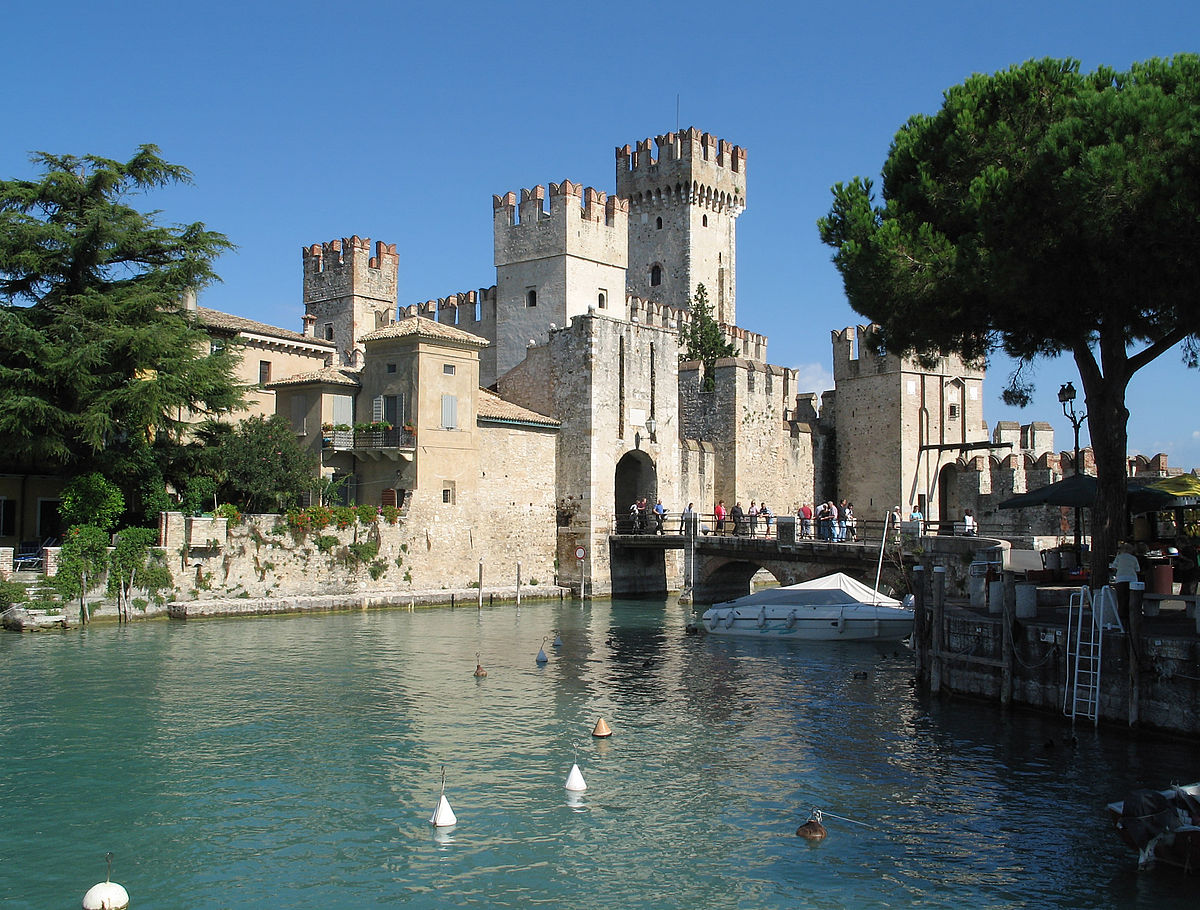
We couldn’t guess when we might see a restaurant, or if the castle area had anything along those lines, so we ate a pretty hotel outdoor restaurant overlooking the western half of the lake, shaded by umbrellas.  Refreshed, we continued our long trek.  We passed hundreds of tourists, including little kids on scooters and ladies with parasols.  I used my neon green umbrella for shade, since sunscreen runs into my eyes when I sweat.  At last, we crossed the moat into the castle area, which is set up like a scenic fishing village.  The castle itself is a beachside fortress, with extensive walls that extend into the harbor.

Since we had paid for parking until 6 PM, and we didn’t know how long things would take, we decided to go to our highest priority site first: the Roman “Grotto of Catullus” on the very tip of the peninsula.  So we walked past the castle and continued our hike through narrow streets choked with tourists.  Tiny cars attempted to push through the tourists, idling at a speed slower than walking, waiting in vain for the crowds to clear.  When we saw what appeared to be a shortcut away from the stifling, shrieking crowds of families, we took it.  We passed beaches full of bathers, and a shrine for Mary, and a children’s park.  There our path dead-ended.

We had to backtrack a ways, and find a better path up the peninsula.  At some point, we noticed a tram stop swarming with tourists, and we gladly paid 1 Euro each to ride the rest of the way in a covered tram.

The Grotto of Catullus

The sun was beating down, but we entered the Roman grotto area, eager to discover the ruins beyond.  Italian museums lack air conditioning.  The path led into a museum, and it had some interesting exhibits, which we were glad to see, despite sweat dripping off our faces and backs.  There were well-preserved Roman mosaic, pillars, utensils, jars, and other artifacts, all discovered at the site.  This lakeside villa used to belong to a wealthy “poet” nobleman who thrived during the time of Augustus Caesar.  The villa was destroyed by fire in the 3rd century, around the time when the Roman Empire was on the wane.  After that time, it was looted and used for various purposes, but the essence of its ancient grandeur lingers.

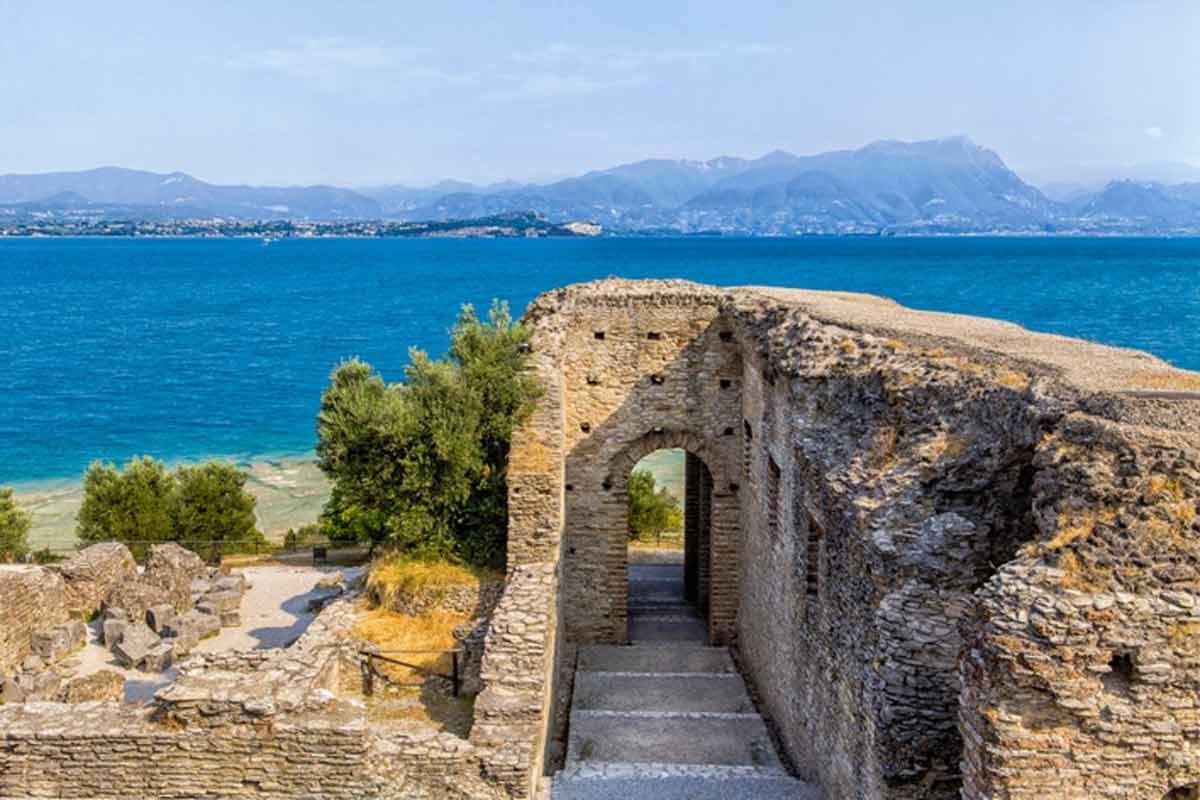
We saw that grandeur for ourselves once we stepped out of the hot museum and encountered a long colonnade of brick arches.  Tourists can explore these ruins at their own pace.  We continued onward, and saw ruined room after ruined room.  One part of the complex is labeled “room with a nice view,” and that’s an understatement.  Lake Garda is a crystal clear aqua color, with cloud-covered mountains as a backdrop.  It’s gorgeous.  This villa must have been a nice retreat for ancient Romans on their way between Rome and Gaul.  Local Italians apparently hang out here and swim in the aqua water, or pilot yachts and motorboats past the grotto.

The most impressive part of the ruins, to me, was a pair of a huge archways that must be four or five stories tall.  The fact that they’re in good condition, after two millenniums, shows that the medieval locals took good care of them, and respected whoever had designed and built them.  One of the archways has initials carved near the keystone at the top.  Someone must have used a ladder to get up there.

Archway at Grotte Catullo on Sirmione, Lake Garda

Archway at Grotte Catullo on Sirmione, Lake Garda

Satisfied that we’d seen what we’d come to see, we figured we had enough time to check out the castle as well.  So we sat at the tram stop and waited.  And waited.  An anxious mob of tourists eyed us.  When the tram finally showed up, it was only hauling one car; not nearly enough room for the mob of people waiting.  We tried to get aboard, but two people can’t compete with families of ten or more.  We couldn’t get on that tram, or the next one, which also took a long time and was also only hauling one car.  Maybe it was the time of the day, but it seemed the trams were no longer adequate.  So we had to walk back in the sweltering heat.  Three miles?  Five?  I have no idea, but altogether, I must have walked at least ten miles that day.  Not good for people with flat feet and plantar fasciitus, especially in a heat wave!

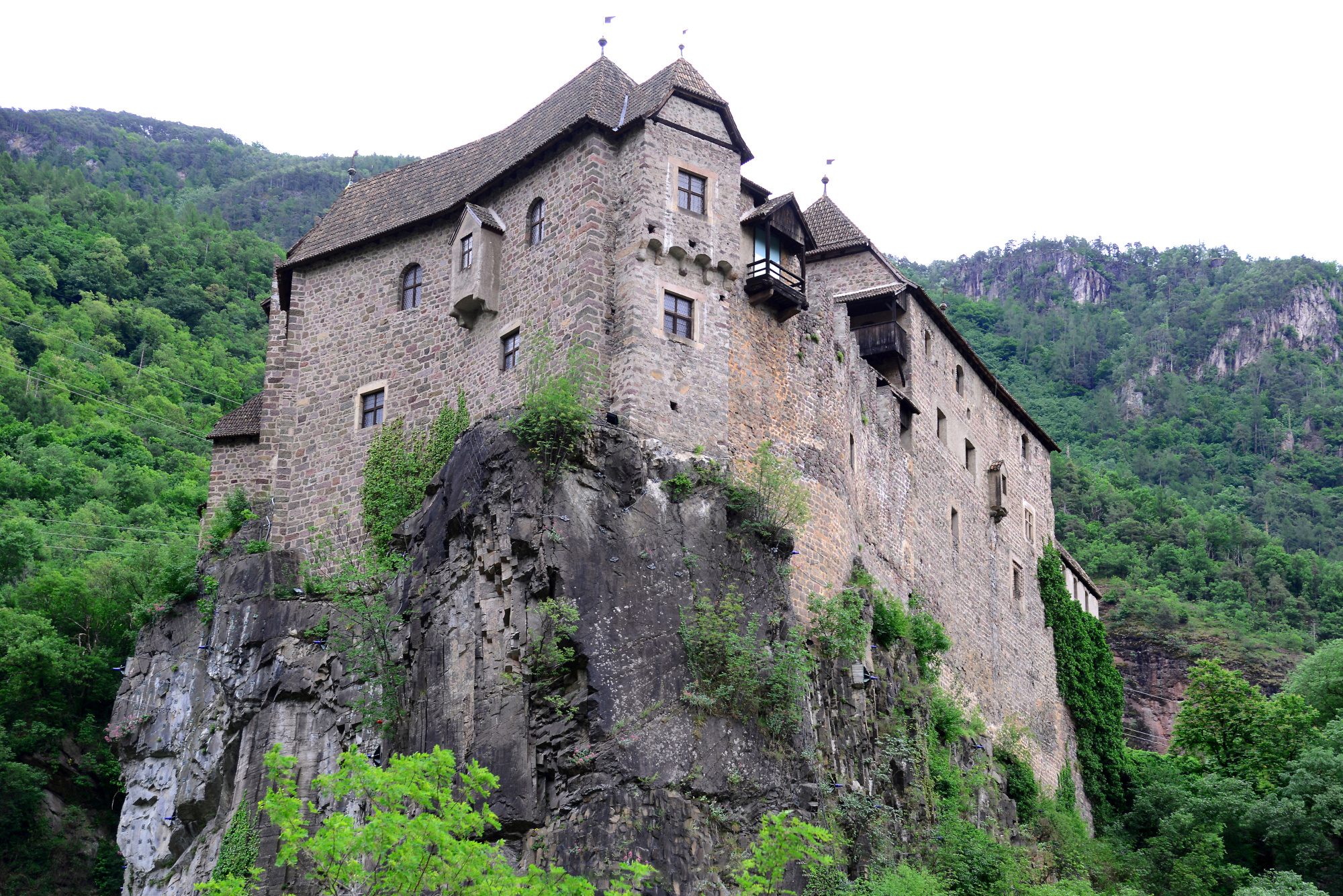
Scaliger Castle on Sirmione

We did take a quick look inside Scaliger Castle.  There are a few drawbridges, but most of what this castle offers to tourists today is beautiful views.  We saw a duck nesting in the moat, and a swan, and some large fish.  From the castle walls, we could see Lake Garda in all directions, as well as the medieval village.

Scaliger Castle, Sirmione on Lake Garda

Scaliger Castle, Sirmione on Lake Garda

We hurried back to our car, trying not to get a parking ticket.  By the end of that walk, we were both soaked in sweat and exhausted.  But I wanted to do dinner out instead of in the apartment, and I figured we must be near a lot of scenic lakeside towns that would soon open their restaurants for dinner.  So we headed to Desenzano del Garda, which is small by Italian standards, but indeed scenic.  Best of all, for us, the parking lot in town had open spaces!

The restaurant we chose looked nice, but it turned out to be the worst of the our trip, with poor service and food quality that was what you’d find in a low-end American chain restaurant.  We watched the sky darken over Lake Garda as the sun set, and wondered at some tourists in strange outfits, and a family with obnoxiously loud blonde children singing and marching in what looked like goose-steps, doing Nazi salutes.

Faulty Validation Tickets!

When we tried to exit the parking lot, the gate wouldn’t open and we got an error message.  So we were stuck inside the lot.  At a loss for what to do, I pressed the button on the machine that said “S.O.S.”  This turned out to be the correct course of action.  An Italian man spoke through the speaker, and he knew enough English to give us very unclear instructions.  He said, “Come to see me.”  Well, he was nowhere in sight.  So I backed my car up a long ways (dangerous in such a narrow aisle, but there was no way to turn around), and we saw a weird booth that looked like a shack.  Amy guessed the parking guy must be inside, and sure enough, he was.  He explained that the validation we’d gotten was faulty, and gave us one that allowed us to exit the lot.

Such a thing can’t happen twice in one night, right?  Apparently it can.  Our second mishap that night was another faulty validation ticket, this time at a tollbooth on the A4 tollway.  The gate wouldn’t let us through.  Once again, I pressed the S.O.S. button.  This time, the Italian man speaking through the staticky speaker sounded a lot less pleasant, and he hardly spoke any English.  After a lot of confusing back-and-forth, during which time the guy sounded angrier and angrier, we explained that we had come from Sirmione, and he told us, “Three Euros.”  That was enough to let us through.

But the worst mishap of that night happened after we were safely back in our Verona apartment and getting ready for bed.  The apartment had two bedrooms; one missing a lock on the door, the other with an old-looking key in the lock.  I opted to use the locked bathroom.  When I was done, I twisted the key to unlock it … and I heard a tiny breaking sound.  After that, nothing I tried could open the door.  I twisted the key every way, I tried to yank it out, I tried to turn the key while turning the door handle in different directions, I tried pushing the key further in, and so forth.  Nothing helped.

Locked in the Bathroom!

So I called for help, and luckily my friends could hear me.  Once they understood that I was trapped in the bathroom, they called the front desk for help.  The nighttime receptionist-manager was alone at the desk, possibly stressed out, and didn’t understand the problem at first.  He entered our apartment, apparently expecting some different problem, and he was surprised when I rattled the door.  “There is a person in there!?” he exclaimed.  Brian and Amy explained that the lock was broken, and he hurried away with assurances that help would be on its way.

I could only hear what was happening outside if I shut off the light, since the light and the fan were operated by the same switch, and the fan was loud.  So I stood by light switch and shut it off whenever I needed to talk to someone.  Brian and Amy assured me that the manager was getting help.  This turned out to be a process that took about an hour, and did not seem to include any locksmith.  The manager returned with a toolkit and attempted to get the key out of the lock, to no avail.  I tried to help from the inside of the door, to no avail.  “But this is incredible!” the manager said, and left again, maybe to find more help.

I wondered if I could sleep on a hard bathroom floor, using a towel for a mattress.  As stressed out as I was, I doubted I would sleep at all.  Meanwhile, Amy was working the far side of the door with the toolkit which the manager had left behind.  She pried off the lock plate, exposing the keyhole.  I could see my friends through the keyhole, but we still couldn’t get the key to slide out or unlock the door.  After a bit more work, Brian jammed the key through the keyhole and it came out in my hands.  The door remained locked.  The stressed-out manager returned, and this time, with the old key removed, he was able to unlock the door using his master key.

I did not lock any more hotel bathroom doors during this trip.

To be continued …

Adventure in Italy: Verona and Venice

Thanks to my friend Amy’s navigation skills, we drove the 3 hours from Turin to Verona without getting lost on confusing unmarked highways and spaghetti-shaped interchange ramps. We checked into the Residence Viale Venezia on the outskirts of town. This dormitory-style apartment was a welcome break for us, since we each got our own private bedroom, and we had booked it for four days. It turned out to be a little on the run-down side, with shower water that turned ice cold at random times due to a mysterious water heater, which we only learned how to reset on the last day. The neighborhood was a little bit sketchy, with homeless people sleeping on the streets.

Verona, Italy

Once settled in, we opted to skip the 2 hour walk around the city in scorching hot weather, but we did hike straight to the center of town to see the ancient Verona Arena, which was built during the 1st century A.D. by the Roman Empire and is still used today for opera performances. This arena looks like the Coliseum in Rome, and although not quite as big, it is better preserved, with a section of the outer wall still standing, and many of the inner gates in use for opera attendees.

Verona Arena

We spontaneously hopped aboard a tourist tram to see the rest of historic Verona. The tram had a loudspeaker recorded loop in three languages, including English. However, it was impossible to hear the recording over the noise of static and four shrieking children seated behind us. I can only guess at what the tram showed us. One site, for sure, was the “balcony of Juliet,” draped with vines, which was supposedly an inspiration for Shakespeare’s Romeo & Juliet.

We had a lovely dinner in the square around the arena, with lots of open-air restaurants and a tourist tram stop. Well-dressed opera-goers strolled through the square, and I noticed some local residents climb sloped rooftops to watch the performance in the arena, or sit on steps to listen. We could hear the opera and the applause inside. Since we walked completely around the arena, we noticed heaps of theatrical props piled outside, including gigantic sphinxes and pharaoh heads larger than cars. And on the way to and from our little excursion, we saw the ancient San Fermo church, and also what looked like a Roman gate.

Every day of our trip has been hot weather, so we end up as bundles of sweat. I needed to do my laundry at the apartment, and Brian warned us that European washers are slow. When I started my laundry around 10 PM, I was disappointed to see “3 h” light up. I assumed that meant 3 hours. When I checked the laundry around midnight, it said “6 h” and it was still going. Very disheartened, I fell asleep and hoped my clothes wouldn’t be wrinkled messes in the morning.  But fortunately, it turned out all right, and I hung my clothes around the apartment to dry. Later on, I heard from Brian and Amy that the wash takes about 3 hours.

A Day Trip to Venice from Verona

During our second day in Verona, Amy stayed in the apartment to recover from lack of sleep. I talked Brian into a day trip to Venice (it didn’t take much persuasion) by train. A quick internet search showed that trains travel regularly from Verona to San Lucia Station on the Grand Canal of Venice, and the trip is as little as 9 Euros per person, and less than two hours. So off we went.

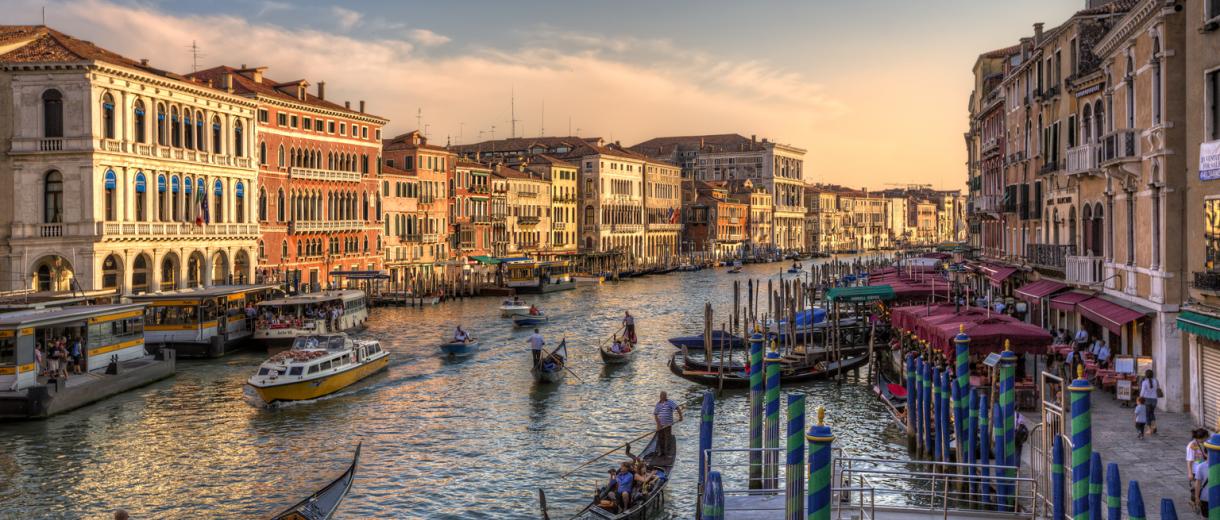
We ate lunch in the Verona Porta Nuova train station, then caught a slow train that arrived in Venice at 3 pm. From there, we had no itinerary, so we crossed a scenic bridge over the Grand Canal and began to explore. Every street looked beautiful and strange. We passed lots of tourists hauling their wheeled suitcases, searching the maze of streets for their hotels. There didn’t seem to be any cars in that part of Venice, but boats serve the same purpose, with large “water buses” and “water taxis,” as well as private motorboats, kayaks, and gondolas with men in striped shirts poling them. The waterways are as busy as city streets.

I wanted a boat tour of the city. We passed some waiting gondolas, but we kept moving when the pole men told the us the price, figuring we could find a less expensive ride elsewhere. We crossed bridge after bridge, and went down crooked and curving streets, and soon got lost, but we figured we’d see the towering domes of big buildings along the Grand Canal and find our way back. Instead, we found other main waterways, with ancient and grand-looking buildings along them. I saw lots of water taxis passing by, so I stood on a dock and called out to one. Sure enough, he was happy to take passengers on a tour and end up back near San Lucia Station. We had the rather large taxi boat to ourselves! And these water taxis are in very good condition, with shiny polished wood. Our driver spoke good English and pointed out sites along the way. We went through some narrow canals where people live, and onto open water which is full of water buses, and so much boat traffic, it’s amazing no one crashed into each other. We passed a Gothic-looking hospital with water ambulances docked outside, and also the island which is used as a cemetery for the city.

Venice Grand Canal

Venice Grand Canal

Once our ride was over, we headed into a marketplace, where I bought some masquerade masks and other items for prices that are probably 1/5th what I’d find in Texas. We had dinner at a lovely restaurant along the Grand Canal, with spikes to scare away seagulls, and a canopy that retracted as soon as the sun went down. Then the lamps all lit up, and it was even more beautiful, with the colors of sunset lingering in the sky.

On the way back to the train station, Brian and I both bought watercolor paintings of Venician scenes from a street vendor; the artist and his daughter. I’ve noticed that the prices for artwork in Italy are seriously lower than what I’ve seen in the States. Food prices are on par, and gasoline is three times as expensive, but good artwork is so affordable, I’m sort of in shock about it.

We took the high speed “Frecciarossa” train back to Verona. Although this train looks aerodynamic, we thought it was not a whole a lot faster than the slow train. It had fewer stops, and we got back around 9 or 9:30 during a sudden thunderstorm. Our plan was to take the bus back to our apartment, but the weather was so gross and the signs were so confusing, we hopped aboard the only bus with the right route number. It turned out to be going in the wrong direction. Six other passengers made the same mistake, so we all had to wait for the bus to get to the end of its route and then loop back in the other direction; maybe 45 minutes extra.

What overseas vacation would be complete without a few mishaps? Keep reading and I’ll get to those….

Adventure in Italy: Isola Bella, Sacra di San Michele, and Turin

Three days go quickly when you’re having fun!  We arrived in Turin, checked into our hotel, then visited the Sacra di San Michele, which is a 10th century monastery on a mountaintop west of Turin.  Like most tourist attractions in Italy, there is a lot of walking once you park.  We hiked up for a ways, past vendors selling souvenirs and cheese, past a man playing a calming musical instrument.  Once we bought our tickets, we were given an English-language brochure so we could follow along with the Italian-only tour group.

Sacra di San Michele

Sacra di San Michele

Sacra di San Michele

The brochure only included five or six points of interest, so I figured it must be skimpy on the information.  The monastery is huge, with multiple turrets, larger than many castles, with extensive grounds and ruins of more ancient structures around it.  But it turns out the tour only goes through a tiny portion of the place, and it does this at a snail’s pace.  The tour guide spent 20+ minutes on each point of interest.  Those of us who do not understand Italian found it tedious. 

But what we were able to see was very impressive, anyway.  The Stairway of the Dead includes several tombs and huge windows, with a very Gothic atmosphere.  We walked underneath Gothic buttresses, and under a Roman funerary slab repurposed with Christian symbology, through a doorway inlaid with serpents and swords.  An elderly Italian nun nearly turned away me and Brian, and we’re not sure why.  After an argument with her, she seemed to realize we were harmless tourists and let us in.  We sat in a mass of pews and then checked out a lot of ancient sarcophagi. 

Later, we walked through a ruined tower where a woman was said to have fallen to escape rapists, and survived due to the intervention of angels, only to die when she threw herself out of the tower again to prove how blessed she was.  The view from this ruined tower is spectacular, and it was especially amazing for us due to an incoming rainstorm over the mountains.  The sun lit up the ruins area while the backdrop was dramatic clouds over steep mountains.

Lake Maggiore, Isola Madre, and Isola Bella

The next day, we went to Lake Maggiore and the Borromean Islands.  We had planned to make a day trip to Portofino, but we decided that was too far a drive for something that sounds scenic-but-overpriced, like a resort.  Isola Bella was closer.  So off we went, and we are very glad that we saw this amazing lake, which has plenty of its own resorts. 

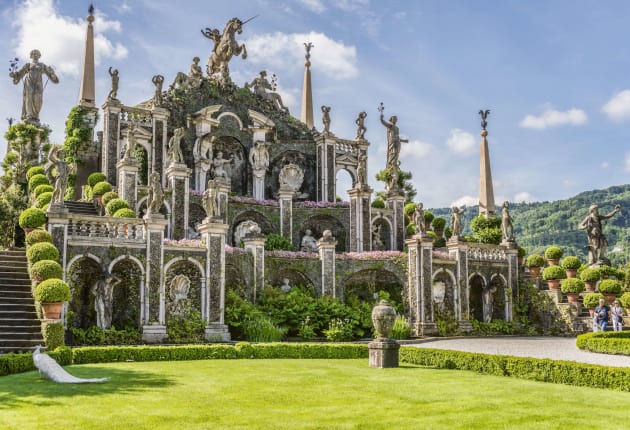
The Borromean Islands were, and I guess still are, owned by ancient royalty whose family crest is the unicorn.  They used a lot of unicorn and clam motifs in their decor, and they apparently had a great sense of style and decor during the baroque period.  At least one of the women in the family was a renowned painter.  Another family member collected exotic plants, and created a truly impressive baroque garden on an island, complete with Roman statues holding bronze sprigs or tools, and albino peacocks roving around.  We glimpsed some kind of pheasant bird colored like a parrot, with crazily bright colors.  There was an extensive grotto with golden horse armor, model ships, and interesting oddities collected during the 18th century.

Isola Bella

Isola Bella

We had to keep an eye on the time in order to catch the ferry boat from one island to the next.  Although we’d bought a ticket for three islands, we only ended up on Isola Madre and Isola Bella, and that was plenty for the day.  After that, on our way home, we stopped to see a statue in Arona which is said to have inspired the Statute of Liberty.  It’s a large statue of a saint, which can be entered and climbed inside.  It was closed when we arrived, which was for the best, since there was an intimidating warning sign about the interior stairs being so narrow and claustrophobic that people aren’t allowed to wear backpacks or carry umbrellas inside.

The Egyptian Museum of Turin

The following day—today—we slated for a relaxed day in the center of Turin.  We spent more than a few hours in the Egyptian Museum, which is a must-see for anyone interested in Egyptology.  This is said to be the biggest collection of artifacts from ancient Egypt outside of Egypt, and it really is a lot.  Egyptian displays usually only have one or two of each thing, whereas this museum had so many artifacts, with such a variety of styles, it gave a better sense of what was commonplace during which dynasty.

Egyptian Museum of Turin

Egyptian Museum of Turin

After that, we stopped for gelato, which is easy to find anywhere touristy, and artfully put into cute dishes.  We ambled to the Plaza Reale, the royal palace, but we didn’t have time to explore the armory and art museums inside.  We checked out the royal garden, but after seeing Isola Bella the day before, it was underwhelming.  So we headed down a few tourist marketplace streets, and explored the narrow alleys of Turin, which are very European and full of street cafes.

Finally, driving back to our hotel at night, we saw lots of street prostitutes.  Which brings me to the topic of our *weird* hotel-motel.  This place looked pretty respectable on the internet when I booked it.  In reality, it is out in the middle of a cornfield, in an industrial park, on a street of hookers.  Brian has a nice room with a key card that works.  Amy and I have had to ask for a new key card every single night, because ours stops working.  And we changed rooms on the first night because of a missing deadbolt and a key card that was non-functional.  The whole atmosphere of this place is creepy, with more staff than guests visible.  It’s dark in the lobby.  There is weird muzak playing softly in very empty hallways.  The showers have mirrors.  There is a giant stuffed animal panda with fake bamboo as the only apparent decoration.  No other hotel art or wallpaper. Now that I know how easy it is to navigate and drive in Turin, I wish I had gotten a hotel in the downtown area instead of on the outskirts.

Overall, Turin seems to be a rundown city, to me.  There is a lot of graffiti and empty streets, with boarded-up shops and restaurants.  Like most places in Italy, shops tend to close by 6 and restaurants shut down from 2 till 7:30.  This gives most of the city a deserted, desolate appearance, with dry leaves blowing across streets.  Only the downtown area, with the major tourist sites, is busy.

Driving in Italy

I’ll end this entry with some notes for North Americans about driving in Italy.  Is it scary?  Yes.  Is it fun?  Sort of, yes.  I’ve learned a few things. 

  1. When you are in a city and you need to make a left turn through a busy intersection with eighteen different lanes and only one traffic light to rule them all, there are no rules and it is a free-for-all, but the traffic sometimes opens up at the last minute and that’s when you can floor the accelerator and get to where you need to go. 
  2. When you are on a super-narrow cliff road with blind hairpin turns, and you can’t see around each corner, and motorcycles and trucks tend to whip around into your lane, it is smart to flash your brights while edging around each turn.  This is what the locals do.  It (hopefully) signals to oncoming drivers that you exist, and might prevent your death.   
  3. When you encounter a major round-about with multiple lanes, always, always, always check your blind spot. 
  4. When you are driving in a city and the upcoming traffic light turns yellow and red at the same time, this is normal and it means yellow.  
  5. When your map shows a road and all you see is a cobblestone alleyway at a very steep angle, don’t trust the map.  You may not be able to turn around. 
  6. Parking signs are often lies.
  7. The autostrada are easy driving and very similar to U.S. interstate highways, but be prepared for tolls of 1 to 16 Euros.

That is all.

Adventure in Italy: Val d’Aosta

As I write this, I’m sitting outside the ristorante at the base of the Hotel Au Soleil in Saint-Vincente, Italia.  We just spent the last two days in the Val d’Aosta, and we’ll be leaving tomorrow morning for Torino (Turin).

I think I’ve leveled up as a driver in the Italian Alps.  The rotaries are beginning to make sense, and so are the tollbooths.  I’ve learned that [P] Parking signs are rarely as close or convenient as they seem, and parking almost always includes a tariff, even if it’s a small one.  I’m driving a hybrid car, which at first had me worried that it would stall out at every red light or stop sign.  It turns out the engine just automatically shuts off when the car is idle, and it turns back on when I hit the gas pedal.  It takes some getting used to, and the car doesn’t have nearly as much “pick up” as I’m used to, but it gets wonderful gas mileage.  Three days into our trip, and we’re only down half a tank.  We haven’t had to fill up yet.

Monte Bianco Skyway

As for the Alps, what can I say?  They are as majestic and amazing as photos indicate.  The peaks are sharp twists of granite, with glaciers and snow between them, and clouds crowning their summits.  It’s 90 F in the valley, and we can see snow, and it looks close.  Earlier today, we drove through a series of mountain tunnels to the Monte Bianco Skyway, and we paid about 49 Euros per person to ride it up to the Helbronner peak.  From that height, about 11,300 feet elevation, we were able to see Switzerland and France, including the Matterhorn in distance (although it was obscured by a wreath of clouds), and the much closer Gigante peak.  I needed my jacket for about five minutes, since Italy is in a heatwave, but it was maybe 50 F at the top.  We saw people snowshoeing across the nearby glacier, and also rock climbing.

The skyway was built in 2015, and it’s really well-engineered—although this week it could have used air conditioning!  They pack a lot of people into the high-speed cable cars, standing room only.  The summit feels a little bit like a party, with a DJ and cool breezes.  There was also a crystal exhibit, showing that early crystal hunters used to climb these peaks in the 18th century to get crystals.

Skyway Monte Bianco

Skyway Monte Bianco

Cogne Valley

After that, we drove to the alpine village of Cogne, which is up a gnarly 12 mile cliffside road.  European drivers whip around the hairpin turns and swerve blindly into oncoming traffic lanes.  It makes me wonder how many of them die every month from cliff road accidents.  Anyway, I earned some experience points going up and down that road without dying, and it was pretty fun.  We looked for the Roman aqueduct which is supposed to be around there, but all we noticed from the road was an ancient-looking wall.  Maybe that was the foundation of an old castle, or maybe it was the remnants of part of the aqueduct.  Moving on, we checked out the Lillaz waterfall, which is very scenic, although it requires a bit of a hike to get to.  Cogne itself is gorgeous, with lots of wildflowers and mountains, and several scenic villages that look very Swiss.

Cogne Valley, Italy

Cogne Valley, Italy

We ended up not having time to visit any castles today, although we saw quite a few castles from the road.  Some looked medieval, some were in ruins, whereas others were more recent and ornate.

Aosta Valley

Yesterday, we spent a large portion of the day walking around the city of Aosta.  Not only is it a beautiful city, but it has an impressive history as a Roman gateway to Gaul.  Not much is left to see from the fallen empire, but there are remnants of a gate, an archway, and some pieces of a theatre left standing.  Against the backdrop of the Alps, this is all impressive to see.  We bought a day pass to see these sites, including a paleochristian church crypt from the 5th century, and an antiquities museum where a lot of local treasures and relics are displayed.  I thought it was interesting to see a chronology of the Roman emperors stamped into ancient coins.  There were underground archeological sites on display, where we were able to walk over plexiglass and see an ancient well, and other remnants.

Aosta Roman theatre relic

Aosta Roman theatre relic

Aosta has a lot of quaint, walkable streets.  We passed the Hotel de Villes, which is very fancy, and there was an artisan street fair out front.  We ended up eating at the Flavours di Val’Aosta, where I ate some kind of mashed chickpeas and candied bell peppers which they called a ‘burger,’ and it was super delicious.  There was an organ grinder to add to the quaint atmosphere.

Speaking of food, so far on this trip to Italy, I’ve been amazed and pleased to be able to find meals without dairy or cheese.  This was something I’d worried about, since I had trouble when I visited Paris in 2012.  But tonight we ate at our hotel restaurant, and they had several non-cheese options.  I enjoyed a steak with veggies, which were much more flavorful than what we might find in American chain restaurants.

Fénis Castle

Yesterday, we also took some time to visit Fénis castle, which is about 15 minutes from our hotel.  They only allow guided tour groups inside, and they told us the guide would only speak Italian, but that was okay with us.  Our guide ended up giving the tour in three languages: Italian, French, and English.  It was clear he hadn’t expected to have guests from a few different countries, but he did a great job!  I thought the most impressive part of the castle was a humongous fireplace used for roasting oxen; probably more than one.  Our group of 20 people or so could all stand inside this fireplace and peer up at the distant chimney, which looked pretty creepy.  This castle was apparently built in the 1200s, had its glory days around the 1500s, was abandoned around the 1700s, and used as a barn in the 1800s.

Fenis Castle

Fenis Castle

Tomorrow we are going to drive to Turin and see what we see.

Adventure in the Italian Alps: Flight Day

My adventure begins.

I’ve looked forward to this trip to northern Italy all year.  It took a lot of planning, and I hope that will pay off.  We ruled out Rome and Naples right away, since it’s the heat of the summer and the height of summer tourism.  I will make a separate trip to those places, preferably in spring or autumn.

It was a lot harder to cut Florence and Venice out of our trip.  The reason was logistics.  We only have a limited time of 12 days (14 days if you include air travel), and I’ve put a high priority on seeing off-the-beaten-track places, such as the Aosta Valley and Sacra di San Michele and Portofino.  Reliable, on-demand public transportation in the Italian Alps looks iffy and hard to find, at least on the internet, so we’re renting a car.  But it seems that having a car will be a pain-in-the-ass in cities.  Venice and Florence have restrictions on non-locals driving around, and travelers who have visited Italy say that driving through intersections and roundabouts in big Italian cities can be a game of “chicken.”  At first, I figured we’d leave the rental car parked somewhere and take a train into those major cities.  But if I made Florence or Venice a priority, I’d have to cut out a number of days in the off-the-beaten track places.  And if I only allocated two or three days to sites in the Alps, it seemed pointless to rent a car, which would transform this vacation into a different kind of trip.  Maybe we could hire an Uber or something, but I’ve been unable to find out how feasible that is in Italy.

So this is my off-the-beaten-track rental car tour of the Italian Alps.  We’ll spend some time in Milan, Turin, and Verona, but also in the Aosta Valley and Lake Garda.  It should be … amazing.  I’m sure I’ll make an effort to return to Italy to see Florence, Venice, Rome, Naples, and the many other places I’ll miss seeing on this trip.

As I write this, I’m in the Austin Airport waiting for the first leg of my journey to JFK in New York.  From there, I’ll take an overnight Emirates flight to Milan which arrives at noon the next day.

I was unable to choose seats on the JetBlue flights through my Emirates reservation.  I thought that was weird, so when I got an error message trying to check in online (“unconfirmed passenger, see a JetBlue representative at the airport”), I had a panic attack.  It turns out they just needed my passport, and apparently they lack any ability to do that online.  So I chose a seat for my return back to Austin in 14 days, and now I’m feeling good!

Thank you to my roommate and coworkers, holding down the fort while I’m gone.

It’s 2018? Holy Crap, Life Got in the Way.

Happy New Year! It’s 2018, and I’ll turn forty in a few weeks.

Some of my peers have enjoyed major leaps forward in their career, or their family, during the past year or two. I don’t feel as if much has changed for me. That’s a frustrating feeling. When I look back at what I accomplished in a year, it doesn’t seem like enough. I finished the final draft of Book 1, and I’m halfway through finalizing Book 2. I also began writing Book 6. I’m on track to finish my enormous epic series this year or next.

But where’s my audience? Shouldn’t I be building my readership? How do I expect to compete with the millions of other SFF authors who are busy promoting and cross-promoting?

Yeah. That’s what I need to work on.

If you are one of my readers, please understand how grateful I am. My blog posts sometimes veer into naked angst, as I’m on the journey to becoming an “authorpreneur,” or self-made author. My heroes are Scott Sigler, Hugh Howey, Andy Weir, Drew Hayes, Michael J. Sullivan, and a bunch of other self-made authors who built an underground following and made it into the mainstream. I want a career like theirs. I write epic sci-fi and fantasy, and I’m confident that I’ve got something original and unique, and, well, exceptionally good. But proving that is different from doing it. There’s writing books, and then there’s selling books, and those two endeavors are not the same.

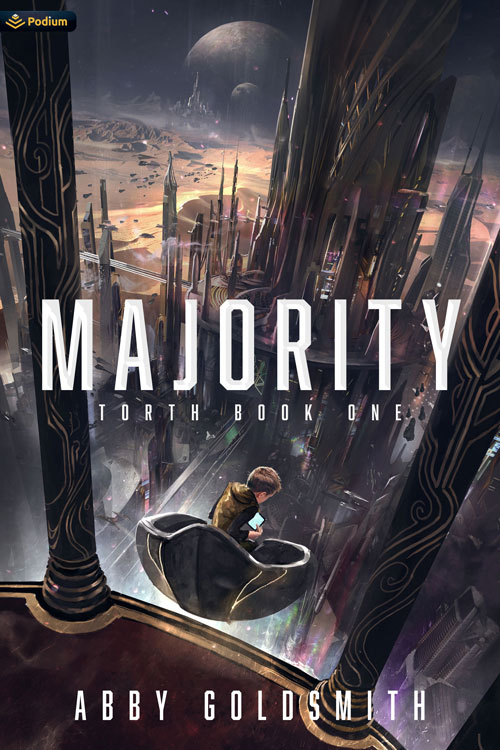
Before I publish Book 1, I need to send out ARCs (advanced reader copies), and ask for reviews and endorsements. I need to firm up my launch plan and set a date. I need a good cover artist, and I need to find a good audiobook narrator. I want to hire a virtual assistant to help me with ads and promo and newsletter activities. I’m afraid of blowing a lot of money on the launch, only to have the whole series fizzle and die along with my author career. This launch will be the culmination of decades of hard work, for me. It’s a once-in-a-lifetime risk. I’ll publish other series, but I doubt I’ll ever put this much effort and stress into one again.

You can help by asking for a copy of the first book of my series. It has an ending, so even if you’re not a series reader, you’ll still get a kick out of it, especially if you have any interest in exploring crowd psychology through a SFF lens. I’ll be happy to send you a free e-book version, in exchange for an honest review when I hit the “publish” button.

Here’s a few highlights from my past year:

  • I enjoyed a vacation in South Korea, right when all those nuclear threats were flying around.
  • I visited New Orleans for the first time, during the French Quarter Festival.
  • I made a few dollars worth of passive income, through RedBubble, 3DExport, and TurboSquid. I only have a few illustrations and 3D art assets for sale, so it’s cool whenever someone buys one, because I know they’re a random browser who doesn’t know who I am.
  • I’m very proud of the short story I have published in the Futuristica sci-fi anthology. This is one of my best.
  • I got into trading cryptocurrencies, and it looks like I may make a few extra hundred or thousand dollars, although nothing is guaranteed in the crypto underworld. It’s a lot more exciting than investing in stocks, since it’s so volatile, with so much mystique.

And a few things upcoming in 2018:

  • I’ll have an article published by Writer’s Digest.
  • I’m going to get a Lasik consultation. Since my eyesight is -10, I probably won’t be eligible for the surgery, but I’m curious about new alternatives, such as lens implants.
  • My travel plans include the Cayman Islands, thanks to the awesome company where I work.
  • And I’m likely going to take a trip Europe later this year, possibly to Scotland, or to Austria.
  • I’m still co-hosting the Stories for Nerds podcast, but I’m considering attempting something strange and new on Twitch.tv.
  • I will try my best not to let being forty years old and single get me down. Treasure what you have.

Interview by Brian Donald Wright

Thanks to Brian Donald Wright for the interview. There are some tidbits in here that I don’t usually share on social media.

Direct Link

Book Review of “The Circle” by Dave Eggers

Mob rule with constant surveillance

The glamour of a Silicon Valley tech utopia rings true, and so does the emerging mob rule, and the shifting values of society, and the wedding of big corporation with surveillance government. These are all things that I think about a lot, since I explore mob rule and constant surveillance in my own writing. I am thrilled to see a successful author who dares to dig deep into those themes. I want to hug Dave Eggers just for that.

The Circle brings up great discussion points related to privacy, the spread of information, the peer pressure of social media, and public sharing of everything. The dialogue is very well-written and plausible, and the prose is smooth sailing, pulling me right along as a reader.

But there are some deeper flaws. The point-of-view character is Mae, and the author made her unreliable, lacking in personality, and sort of stupid. He clearly made her that way on purpose, and I’m guessing he did it to emphasize how an “ordinary person” can drink the Kool-Aid of a seeming utopia that exists at the expense of privacy. I like that character choice. It should have worked well … except Mae is barely plausible as an ordinary person. She accepts every suggestion and opinion of her bosses, and she’s oblivious to other people’s pain. She values privacy at first, but then capitulates without any thought or rationale. She has casual sex with strangers, without any of the worries that real women have. She’s just shallow. She comes across as a generic hot chick as written by a guy who probably views women with condescension.

This is a cautionary tale. In my opinion, it could come across as a stronger wake-up call to society if 1) the main character had stronger “nice-but-naive” traits, and 2) if the pro-privacy people in the book used stronger arguments. Not a single one of them mentions the major problems inherent in mob rule. Everyone in this book assumes that sharing everything ensures that crimes can be avoided, yet no one brings up the obvious argument that society decides what a crime is. In some countries, it’s a crime for women to laugh in public, or to get urgent medical care without a male chaperone. They never talk about that in their visions of a global utopia. The whole society is just apparently derp-de-derp oblivious.

It’s still a really good book, and a really relevant tale for our times. Please read it if you’re on the fence. I’d be happy to discuss it.

The Circle by Dave Eggers

Short Fiction “Across an Aeon” — Futuristica Anthology

I’m pleased to have a short science fiction story featured in Futuristica vol II, just published in May 2017 by Metasagas Press. “Across an Aeon” is about a woman who breaks laws to take a one-way trip to the far distant future in search of her missing husband and daughter. There she finds the unexpected and intertwined fates of humankind, the planet Earth, and what happened to the people she loves.

I’m really proud of this story. I think it’s one of my best short fiction pieces.

Time Travel Fiction

For some deeply buried psychological reason, I keep exploring time travel in my short fiction, although I avoid that can of worms in my novels. My previous short stories about time travel are freely available on Twilight Times and Escape Pod.

Acknowledgements

Thank you to Chester Hoster and Katy Stauber at Metasagas Press for their work in editing and publishing the Futuristica anthologies. I really appreciate their generosity with contributor’s copies, and their dedication to communicating with the authors and staying professional in every respect. Shout-out to Zach Chapman, whose story about gaming and VR also appears in this anthology. I’m looking forward to reading it. And the rest of them!

E-Reader Simulator Across All Platforms

Apparently, there’s no such thing as a simulator for testing .epub files (e-books) across all e-reader platforms and devices, because that would make life too easy. Kindle has their Kindle Previewer tool, but where’s an equivalent simulator for testing .epub files on Kobo, Nook, and iBooks?

Well, you can use your phone + Dropbox. It’s a bit of a hassle, but you can check the quality of your e-book like a pro, and use these steps to send a product to your readers that you can be proud to stand behind.

  1. Install Dropbox on your phone or device, if it’s not there already. Install the Kobo reader app on your phone or device. Sign in and get it all set up. Do the same for the Nook reader app. If you’re on an iPhone or iPad, you should already have iBooks installed. Sign in and get yourself set up, if you haven’t already.
  2. Make a Dropbox folder for testing your ebook. Toss your .epub into that folder.
  3. On your phone/device: Open Dropbox and try to open your .epub. It says the file can’t be viewed.
  4. Select the three dots for settings > Export
  5. Select “Open In” (the Applications icon)
  6. Scroll through the app icons until you see “Copy to Kobo” or “Copy to Nook” or “Copy to iBooks”. Select one and your .epub will open in that application.


Thanks to NookPress for their useful article on Tools for Testing Your E-Books.

« Older posts Newer posts »
© 2026 Abby Goldsmith DBA Fiery Press